A Mushy, Wormy AAPL

Somehow, Apple has regained its crown.
With a market cap of $4.84 trillion, it is once again the largest company in the world.
But frankly, this stock looks a bit mushy. Under its shiny silver skin, there are worms tunnelling.
In its latest quarterly report, Apple posted 12% YoY revenue growth. Not bad, not great. But it’s only forecasting 7-10% growth over the next year. Growth is decelerating.
The valuation is where I get completely lost. Today AAPL trades at 37x earnings (P/E). And it’s valued at a shocking 10.3x revenue (price-to-sales).
The only time in its history Apple had a higher price-to-sales ratio was on its IPO day in 1980. Back then, when the company was worth $1 billion, it traded at 13x sales. But revenue was growing 145%! 10x higher than today.
Meanwhile the dividend yield is now a tiny 0.32%. The company spends most of its cash flow on share buybacks, which helps keep the price inflated.
This is an extremely rich valuation. If I buy a stock priced like that, I expect big growth going forward. At this point, Apple isn’t going to deliver that.
I built the table below to show just how crazy things have gotten. During Apple’s rapid iPhone growth phase, the company was far cheaper than today.
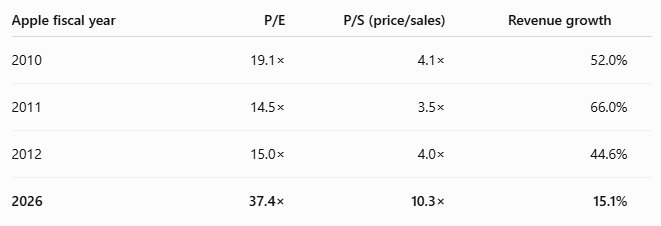
So in 2011, when Apple was growing revenue at 66% a year, it traded at 14.5x earnings. Back then, the stock traded at 3.5x revenue.
In 2011, the company was growing 4.4x faster. Yet it was far cheaper.
Here’s a longer-term view of Apple’s price-to-sales ratio.
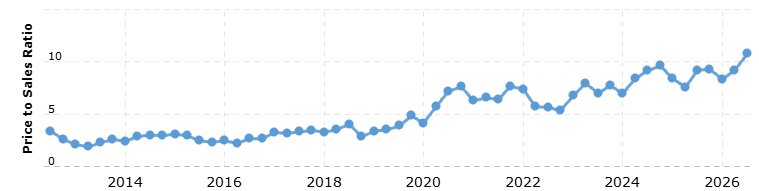
Source: Macrotrends
As you can see, before Covid, Apple always traded at a fairly reasonable valuation (under 5x revenue). But ever since, the old valuation rules have been thrown out the window.
With only 12% annual revenue growth, and little innovation, why are people paying such a premium to own this company?
Tech: The New Safe Haven?
It seems to me that investors are treating big tech as the new safe haven. These stocks have done so well for so long, that many people have come to view them as the safest asset in the world.
Take a look at the chart below, shared by WisdomTree’s Jeff Weniger a few months back:
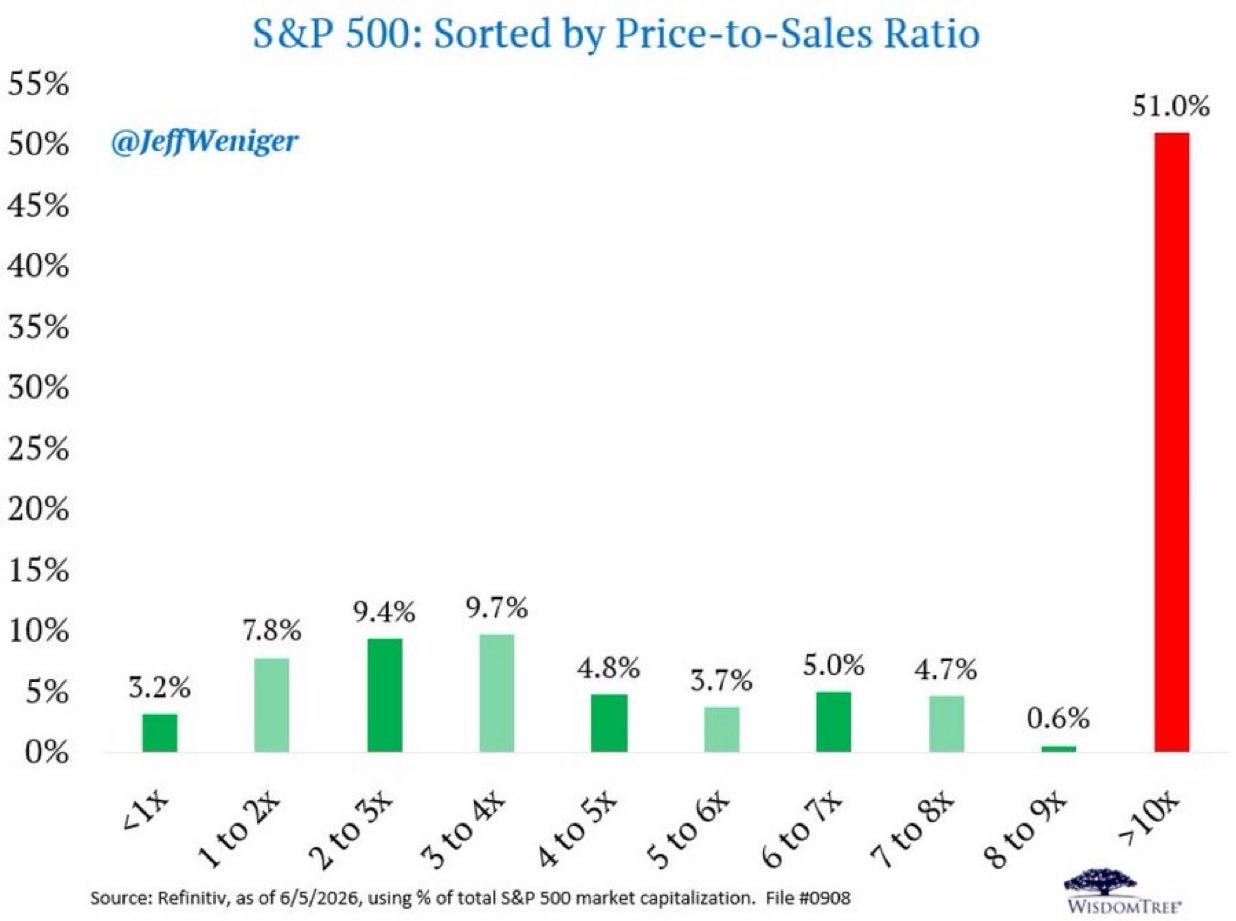
So 51% of the S&P 500 trades at more than a 10x price-to-sales ratio. This is not normal, or healthy.
A 10x sales multiple is extreme. When you buy a mature stock at a valuation like this, be prepared for disappointment unless everything goes perfectly.
“What Were You Thinking?”
Sun Microsystems was one of the hottest hardware stocks during the dotcom boom. From its 1986 IPO to the peak in 2000, it soared 257x.
It was a beautiful growth story. But eventually investors got overly excited and bid the shares up to silly prices.
After the dotcom bubble burst in 2000, Sun shares collapsed 96%.
In an interview with Business Week, Sun’s CEO Scott McNealy admonished shareholders for buying the stock at such a ridiculous price. It’s one of the most fascinating pieces of the entire dotcom bubble saga.
And it really spells out exactly what it means when you buy a stock at 10x revenue:
At 10 times revenues, to give you a 10-year payback, I have to pay you 100% of revenues for 10 straight years in dividends. That assumes I can get that by my shareholders.
That assumes I have zero cost of goods sold, which is very hard for a computer company. That assumes zero expenses, which is really hard with 39,000 employees.
That assumes I pay no taxes, which is very hard. And that assumes you pay no taxes on your dividends, which is kind of illegal. And that assumes with zero R&D for the next 10 years, I can maintain the current revenue run rate.
Now, having done that, would any of you like to buy my stock at $64? Do you realize how ridiculous those basic assumptions are? You don’t need any transparency. You don’t need any footnotes. What were you thinking?
So. Here we are, with over half of the S&P 500 trading at more than 10x revenue.
Human nature hasn’t changed since the dotcom boom. It just took a while to forget the lessons we learned from that crash.
This is how the cycle works. Breakthrough, boom, bubble, bust. Rinse, forget, repeat.
Investors are still ruled by the same animalistic spirits. We are impulsive, emotional, and vulnerable to FOMO.
Every so often, we have to re-learn the bubble lesson. It’s simply part of the game.