My #1 Freak Weather Trade

Have you noticed how weird weather patterns are right now? A Learjet just dropped out of the sky about 8 miles from Mara Lago.
The culprit was severe weather. This is normally the start of the calm dry season for Florida. But that storm dropped over 16 inches of rain in a day. That’s nearly unimaginable.
It was one of five “1,000 year” flood events. Henderson Nevada, Pearl River County Mississippi, Palm Beach Gardens Florida, San Luis Valley Colorado, and Southern Brevard County Florida all saw massive rainfall in the past few days.
These anomalies are part of a massive weather disruption. This is the result of an observed climate phenomenon that dates back tens of thousands of years. El Nino is the name for a periodic warming of the equatorial waters of the Pacific Ocean off Peru.
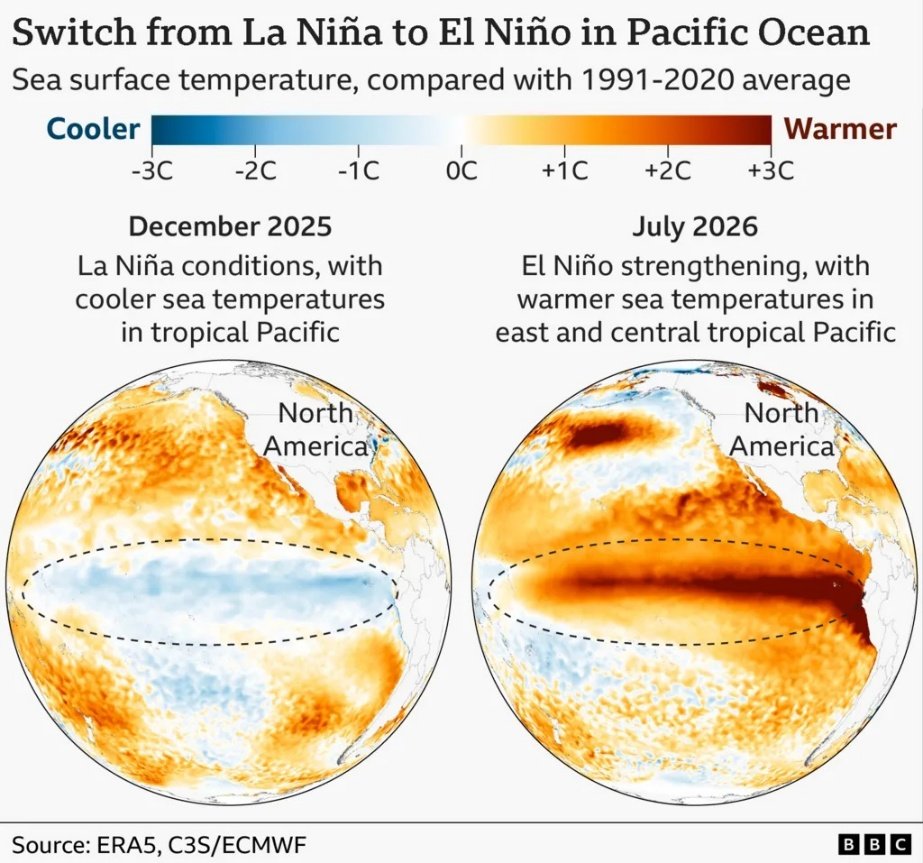
That red area is tongue of about 620,000 cubic kilometers of Pacific Ocean. It is much warmer than normal. Here’s the crazy thing…even a 1 degree increase in temperature across that much water stores heat equal to about 80,000 years of output from a one-gigawatt power plant. A 2 degree increase puts that at 161,000 years.
As you can see, a large swath of that water is over 3 degrees warmer than normal. And a 3-degree increase would need 241,000 years of that power plant output.
And what all that heat does is change the weather. All over the world. But we can’t forecast it with much authority because we’ve never seen an El Nino like this one. What we do see, here in the U.S. is an unusually active southern jet stream. That’s the one that brings moisture in from the Pacific and up from the Gulf of Mexico.
During warm months, the jet brings historic flooding rain. But in the winter it depends on the temperature. If the weather is warm, it’ll just rain. But if it’s cold, you get massive blizzards. That’s where the potential for a run on natural gas comes in.
Because another weather pattern just emerged that will have a direct effect on the U.S. this winter – disrupted polar vortex.
We usually hear stories about the polar vortex in the winter, just before we get a major cold snap. But this year it happened in October. Normally, we would see the polar vortex strengthening. Days are shorter and colder. The vortex strengthens. The strong winds circle the globe close to the pole.
But instead, we see a disrupted pattern today. weak winds and stratospheric warming. The normal seasonal strengthening gets derailed. And while this doesn’t signal an unseasonable cold snap now, it does increase the chances of major cold snaps this winter. And that creates the potential for outsized snowstorms in the mid-Atlantic states.
Normally, these events increase the chance of persistent winter weather patterns. Cold outbreaks in Europe, Asia, and the Eastern U.S. It also sets up blocking patterns that change storm tracks. For example, the Atlantic storms track further south. That leaves colder, drier conditions in Northern Europe.
That’s where we may have a huge opportunity this year. Because a cold Europe and Eastern U.S. means increased demands for natural gas.
Now not every stratospheric warming event increases natural gas demand. But this is an exceptional year. All the events seem to be larger. And so could the cold events.
In Europe, a study found that extreme electricity demand spikes are 1.5 to 3 times more likely during these events. In 2018, there was a massive spike in natural gas demand from a polar vortex.
The opportunity here is that natural gas is cheap and we have an unprecedented weather phenomenon going on.
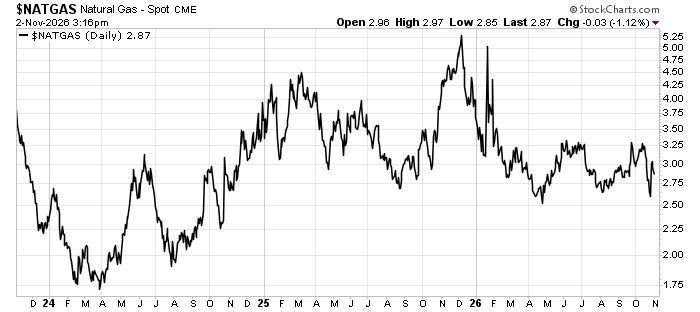
As you can see, natural gas prices just bounce off their lowest price since April. And the April low was its lowest since 2024. We do have a lot of natural gas in the U.S., thanks to record U.S. oil production.
However, we are exporting far more gas than ever before. In August 2026, the U.S. exported 841 million cubic feet of natural gas. In the first six months of 2026, we exported 74% of the total for 2025. A per month average looked like this:
- 2024: 642 million cubic feet per month
- 2025: 747 million cubic feet per month
- 2026: 827 million cubic feet per month
These are export numbers. And they represent about 30% of domestic consumption today. And while export volume is up dramatically, domestic demand is relatively flat.
Demand for exports is soaring thanks to the wars in Ukraine and Iran. And that’s fine right now. But if we get a big spike in demand here in the U.S., prices will jump.
It happened last January with Winter Storm Fern. It sent natural gas futures up as much as 75%. The United States Natural Gas Fund (NYSE: UNG) saw shares jump from $10.30 to $17.00 per share in just a few weeks:
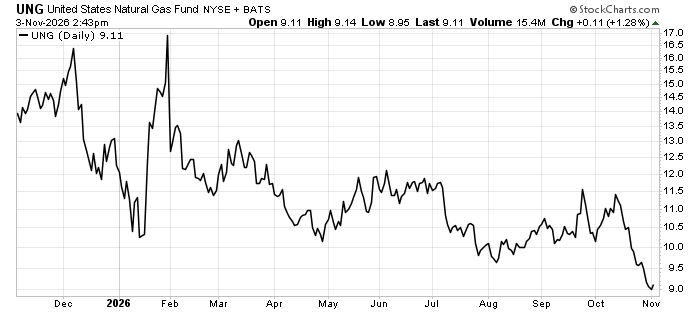
This winter has that potential as well. And UNG is at its lowest price ever. While this fund is an imperfect vehicle for playing natural gas prices over the long term, it’s perfect for a short-term winter trade.
We should buy it now and hold it through March 2027. It should be an easy 60% to 100% gain if we get the kind of snowstorms that look likely, thanks to El Nino.